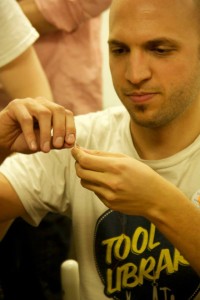
 Lawrence Alvarez is the Co-Founder of The Toronto Tool Library, a collaborative resource sharing project with two locations in Toronto. Canada Curator Lucy Gao spoke with Lawrence to discuss the growing success of the Tool Library, collaborative consumption in Toronto, and the rise of a new resource-based economy.
How does the Tool Library work?
Members have access to over 2000 tools for only $50 a year, which are taken out just like library books. Our tools range from simple screw drivers and drills to table saws, welding equipment and even a full wood shop. We’ve also got a mini seed library, an open-sourced 3D printer, household items like pressure washers, and kitchen equipment like pasta makers and Vitamixes housed in our Kitchen Library.
What’s the mission of the Tool Library?
We aim to remove the economic barrier between people and the basic tools they need to improve their lives. If someone can’t afford membership, we find a way to sponsor them. Our library strives to have all the tools that our members would need, taking requests and even reimbursing members for tools they bought that are now shared library tools. We also have “open community nights” every Wednesday, where we give everyone free access to all the tools in the library. We also encourage our members to teach classes. We want to be a community space where people can request workshops or teach workshops, a space where everyone is constantly learning from each other.
How did it all come about?
I’m the President of a non-profit organization called the Institute for a Resource Based Economy (IRBE), which envisions a sustainable world both ecologically and economically. We wanted to work on a project that was disruptive in a constructive way, something that encouraged sharing but also challenged the way we think about resources. Once we decided on a tool library and got the word out, we started getting lots of tools donated to us and hardly had to buy any tools at all, which was very encouraging. Plus we got a lot of great publicity from a ton of media outlets in Toronto, which really helped it take off.
Tell us about your 3D printing program.
We first heard about 3D printers in 2011 and through the IRBE, started teaching classes about various types of 3D printing, like concrete printing and printing innovative medical devices. We could see it was a game changer, a disruptive technology that empowers us to easily produce things ourselves. Now that we have our own, we offer classes on how to design and print objects, plus we also use it to repair tools by printing out the specific pieces that are broken.
How do people react to this new model of renting tools?
Before we launched the Tool Library, there was a lot of skepticism; people didn’t know how it could work. But once we opened, people would walk in for the first time and be blown away by the space, not only by the large amount of tools but also by the community vibe. It’s a very supportive environment. I feel like the general public tends to be skeptical at first about a lot of these sharing systems, as they may be a bit out of their comfort zone partaking in these activities. But once they experience it themselves, they realize the benefits of doing so and are open to try other sharing platforms as well.
How do you respond to critics who have issues about theft, damages, or people taking advantage of the tool library?
We’ve had over 2800 successful tool loans and a near 100% return rate. I think people understand that they’re accountable to the community. If you steal a tool, you’re taking it from your friends, peers, and your neighbourhood. It’s implicit that when you see the tools, you see it’s a community resource.
Tell us about your crowdfunding campaign.
We knew that we would need a lot of money to open our 2nd location. Crowdfunding was a great way to raise money as it made a lot of sense for people in our community to support our campaign where membership was one of the rewards. We used the Centre for Social Innovation’s crowdfunding platform Catalyst and managed to raise $16000, half of which we got in the last 9 days (albeit a very tense 9 days).
What do you think about the collaborative consumption movement?
It’s definitely moving forward and seems to be growing. Through the Tool Library, I’ve become more exposed to other collcons organizations in Toronto because now I’m a provider of one of these resources. There are so many amazing initiatives in our city and the people who lead them are so humble, selfless, passionate, and committed to doing this for the greater good of the city. We can all benefit from a greater network to share resources and connect with other like-minded entrepreneurs, enthusiasts and citizens. We have to figure out how to galvanize this energy to take sharing to the next level.
What’s your vision for the future of the Tool Library?
In the future, we’d want to be a resource sharing hub with more than just single classes of items. We’d want to be a centre where, for a minimal membership or free if possible, people can access all of the resources they need. This could be bicycles, board games, art, media equipment, air mattresses – anything you don’t use on a regular basis.
There will always be scarcity if things are owned as opposed to shared, since there will never be enough for everyone. How do you unlock the abundance in a community? You share. Everyone should release all their stuff in their basements to shared community hubs. It just makes sense. Lower waste, lower consumption, building community, meeting people, skill sharing – all of this follows the idea of cheaper, accessible tools.
See the Toronto Tool Library featured on CSI’s TV Series below

Great article. The Tool Library is an amazing place!
Would love to read more on the ‘Institute for a Resourced-Based Economy’ (IRBE).