
 BlaBlaCar is an innovative start-up that connects drivers with people travelling the same way. With over three million registered users across Europe, BlaBlaCar provides a smart, social and sustainable travel solution.
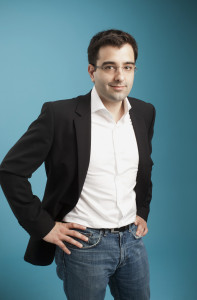
Belgian Curator Marco Torregrossa sat down with Nicolas in Brussels to get the latest scoop on BlaBlaCar.
You were nominated for the Best International Startup Award of Techcrunch. What makes BlaBlaCar different from the other nominees or those who did not make it to the list? What is the secret sauce of BlaBlaCar?
I think we were nominated because in the last years we demonstrated to be a truly international company with a multi local approach, close to the users and the native cultures. We started from Paris and expanded all over Europe and this was our intention from the very early days. We are using a quite unique business model, we employ country managers to whom we are giving strong autonomy to organise their local teams, marketing, PR and decision making approach. It’s a distributed model that is very bottom up. We make sure our teams are made of people with international backgrounds, speaking different languages and with DNA fully rooted in the European culture.
Could you explain your D.R.E.A.M.S. model, how did you come up with that and what advice you have for other entrepreneurs trying to effectively brand their collaborative consumption services?
D.R.E.A.M.S. is our proposed framework for the collaborative economy. It stands for Declared, Rated, Engaged, Activity-Based, Moderated and Social. None of these factors alone make a big different but all of them together do. After years of market experience, we learned these are recurrent components that when deployed they create trust in online sharing marketplaces and enable the success of every peer-to-peer services, even beyond ride sharing and across verticals. The trust factor is very important in our business, we are trying to build a truly collaborative consumption community and enhance social interactions. When one needs to be in other people’s cars, because of the physical proximity, trust is even more important than when you share accommodation space as in that case you may not even be in your flat when you rent out a spare room. We have conducted some surveys, extracting information from the community and found out the more users fill their online profiles the more they reach higher trust levels which empowers them to transact with one another. And this is virtuous circle, the more users we have the more trust we generate in the community so that we are able to unlock a larger market.
With our D.R.E.A.M.S. model we hope to bring valuable knowledge and insight to other sharing economy entrepreneurs, allowing more and better shared transactions. My advice to entrepreneurs is to invest in their brand only when they reach scale. First one should focus on building liquidity and value to the community and then reinforce the brand, which over time builds up your leadership in this space.
What great things do you think we should be watching for in 2014 regarding collaborative consumption?
The sharing economy sector is evolving quickly, we observed that marketplaces are moving from the sharing of higher value/costs assets (cars, accommodation) to lower value ones like every day stuff. I think this development will reach momentum in 2014 and help to mainstream the sharing economy even further. Another development to watch is of course the Internet of Things and how our cars will be more and more connected to our devices and become more sharable.
Car sharing is probably the collaborative consumption sector with the greatest traction in Europe. Is there a need for more research to identify the right metrics that measure the impact of car sharing? How to make sure that car sharing leads to more sustainable transport and avoid the “rebound effect” whereby money saved is reused into long distance travel with more kilometres driven and related CO2 emissions?
Our drivers are not professionals and do not make a profit or a living out of transporting other people. We cap the maximum price a driver can ask for, to make sure this remains a cost sharing activity as opposed to a profit making one for the drivers. Essentially, they carry people in their cars because they already have to drive somewhere and want to offset some costs. This way we avoid our drivers making a business out of ride sharing, which would result in putting more cars on the road.
“I would never get in a car with a stranger”. Unfortunately I heard this a few times. What is your counter argument? Do you think regulations at European level regarding consumer protection, safety, passenger rights and insurance would need to be adapted?
As we are shaping the ride sharing market, our job is to create more transparency, more verifications, and more checks and this in turns generates more trust. For instance, a lady could choose another lady as a driver. My advice to those sceptical is to try our service and it is guaranteed they will love it!
As to policies, we are not facing regulatory issues at the moment because the ride sharing sector is barely regulated at the European or national level. As explained before, our drivers do not make a profit so they do not fall into the category of professional transporters (like UBER drivers) who have to respect regulations on safety or be insured. However, we have a very powerful argument to use with regulators. We have done studies to quantify the occupancy rate of our cars, which is 2.7 passengers per car as opposed to the European level which is as low as 1.3 passenger per car in some countries. If you occupy a seat that would have otherwise been empty, this results in almost zero carbon footprint as any other means of transport, even trains, would result in higher CO2 emissions. The other point is that by offering low cost rates for passengers, we create demand and access, particularly for those who cannot afford high travel costs and this has a powerful social cohesion value.
Are you taking proactive steps with the law makers to incentivise public investments (e.g. European Union grants) for car sharing projects in Europe?
In Europe we have always innovated in the transport sector and I trust more support will come from the public sector in this direction. We are currently exploring our options for a European funded project whereby we could establish shared pick up / drop off points for ride sharing in strategic parts of large cities in different European countries. It would be great if such project could be supported by both public and private partners.
Which is your dream place where you would love to see BlaBlaCar logo one day?
I would love one day to see our logo on the big billboard of Nasdaq on Time Square in New York. That would mean we made it to the stock exchange and to Wall Street! That would also mean ridesharing has become global, mainstream and a viable new transport network. For us, as for collaborative consumption, that would be a great sign of accomplishment.