
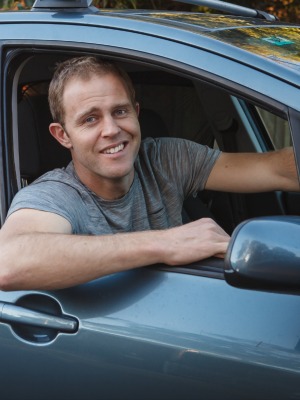
 Will Davies is the founder of Car Next Door, a peer-to-peer car sharing service based in Australia. In this interview, Will talks about what fueled him to start the company and also shares some of the speed bumps the company faces in order to grow in Australia.
1. Describe Car Next Door to someone who hasn’t used it before
Car Next Door is a neighbour-to-neighbour car sharing service. We provide an online platform and in-car technology that turns any car into a share car. This means you can rent your car out when you’re not using it (which, for a lot of people, is most of the time). Or if you don’t have a car, you can rent one by the hour or day from real people in your community.
2. Why did you see the need for a service like Car Next Door?
There are so many cars on the streets already – and if the current rates of car ownership persist, our cities will just keep getting more and more clogged with cars. We need innovative solutions that let people get the mobility they want without needing to own a car. We saw a huge resource in all of the idling capacity of the cars sitting going nowhere in every street. Car Next Door can bring car sharing to more people, in more places, much more rapidly than would otherwise be possible.
3. Do you notice a difference of usage among the suburbs where Car Next Door operates?
We started in Bondi, so we still get the majority of our use there. However in November last year we expanded to the inner west of Sydney, then in February into the inner suburbs of Melbourne, and April to more suburbs in Sydney. It takes a few months to build up a network of cars and borrowers an area, but over a relatively short period of time, cars start to build a solid borrower base and they get busy.
4. What are some of the challenges you have faced in bringing Car Next Door to life? How are you overcoming them?
Regulatory challenges:
It’s actually really complex to build a platform that gives users a simple and hassle-free experience. The software for the booking and payment systems, and the in-car technology that we install in the cars, is complex and takes a lot of getting your head around. Luckily I’ve got a great CTO, Dave Trumbull, as my co-founder and he is all over that stuff.
Creating policies and processes. EVERYTHING we do is pretty much new, and we are working it out as we go. There is very little precedent to follow – we are creating the precedents. That means that nearly everything we do and create needs to have all of the different possible outcomes thought through and examined. Every day something will happen that means that we have to create a new process or adapt existing ones. For example, we just finished putting together a process so that we are checking the road worthiness of the victorian cars each year ( VIC roads doesn’t require a formal check).
5. What do you envision for Car Next Door in the future?
Our aim is to see 10,000 cars being shared by 180,000 people around all of Australia’s major cities. We want to create a network that means that pretty much anyone who lives in a city can access a car when they need it within 5 minutes walk, without having to own one. This means that people can feel secure not needing to own their own car. We know that when people don’t own a car, they do a lot less of that ‘automatic’ driving and choose other transport modes more often. Our main goal (somewhat paradoxically) is to get people out of cars, and get them using public transport, riding & walking. The best way to do this is to create a way to make it attractive not to own your own car, with all its associated expenses. We think that neighbour-to-neighbour car share is the best way to achieve this goal quickly.
Car Next Door by the numbers:
– There are around 150 car owner members and 2,200 borrower members
-Number of suburbs served: around 58 suburbs across Sydney and Melbourne where people have access to a Car Next Door car
– Number of trips to date (as of 11 August): 5,431
– Number of booking hours to date (as of 11 August) – 94,989
– our carbon offset stats (from when we started operating on 24 December 2012 up to 31 May 2014): we offset emissions from 22,900 L of fuel, or 313,693 km, which is equivalent to taking 21 cars off the road for a year.
-Average owner makes $220-250 per month
-the average daily booking is 1.2 days
– the average hourly booking is 3 hours