
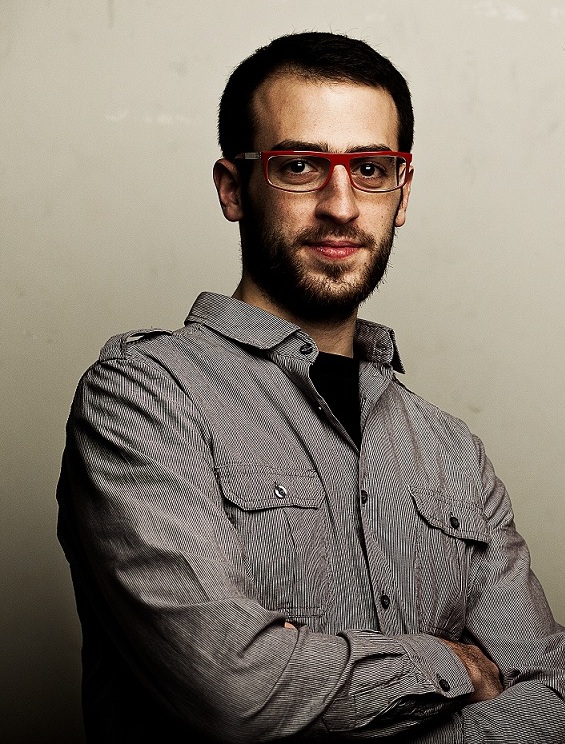
 Cookisto is a trusted community marketplace for homemade food. It is here that hungry foodies find personalised, delicious and healthy homemade food prepared by talented home cooks. Belgian Curator Marco Torregrossa had a chat with Michalis about good food and how a movement around meal sharing is developing in Europe.
Michalis, you are Greek, so you may know a thing of two about good food. What makes the Greek start-up scene unique? What burning passion motivated you to start a business in the collaborative consumption sector?
I’ve always been very passionate about food. My master thesis, which I have done in the framework of a global entrepreneurship program, was about Cookisto and I launched the company immediately after I graduated.
After my studies I felt ready to start something on my own and I wanted to combine my two great passions: eating healthy homemade food and meeting great people. It was after I spent a semester in US where I used airbnb, relayrides and taskrabbit that I was convinced this is the future. So I decided to bring to life an idea which seemed crazy at the beginning: the realisation that stuff and material possessions are not the important things in life, but instead meaningful relationships with people.
“If I had to describe Greek start-ups I would use three words: young, promising and ambitious”.
I don’t know if the Greek start-up ecosystem is unique, for sure Greece is a place with many problems and many problems create opportunities. Just because of the crisis, entrepreneurship is no longer perceived as risky, instead it is an opportunity for restructuring. I think the whole meaning of entrepreneurship is to identify problems and try to solve them by nurturing opportunities in an economical and sustainable way.
Why would someone want to open their home to complete strangers, and to cook a meal for them? Is it for everyone? How do you convince the sceptics?
Cookisto is for everyone, hungry foodies can access homemade meals and passionate home cooks share their cooking skills. We see this as a win-win, although it does not mean everyone is ready right now. It is normal to have early adopters and those who will take longer time until they embrace new and innovative concepts like Cookisto. Technologies nowadays make it so much easier to trust strangers and researches show that the number of people using sharing services is growing extremely fast every year.
If people are sceptic you can’t convince them that the sharing economy is the future, they just need time to hear more opinions from other people who have used successfully collaborative services. For instance, we tried to persuade for a long time and without success the father of one of the other Cookisto founder, who is a restaurant owner. After some months I learnt that he travelled to Italy and stayed at an airbnb flat. He now rents his own flat in Athens through airbnb and totally embraced the collaborative consumption movement. This proved he just needed a longer time to understand the concept. It’s also a generational shift. For instance, my grandparents got the idea of collaborative consumption much better than my parents’ generation and this is probably because they did not grow up in the mass consumerism age.
How does Cookisto cooperate with other collaborative consumption marketplaces? Have you partnered with other start-ups perhaps in a different sector? Do you expect corporate giants or large restaurant chains to jump into the meal sharing sector? What would be their interest and what’s going to happen in terms of partnerships/acquisitions in the future?
In general we don’t have specific partnerships with other collaborative consumption marketplaces but we do network at lot with other start-ups and we are also a member of peers. Sometimes we even organise peer to peer mentorship sessions in Athens and London (where we just launched a few months ago). Finally we have recently organised a large event in Athens with other start-ups and we hope this could raise awareness of the general public and the politicians around the collaborative economy in Greece. Practically, we are trying to be active ambassadors of the sharing economy and educate people as much as we can.
I am not sure the catering industry, including fast foods or large chains with a global presence will seek partnerships with meal sharing platforms any soon. However, I believe that collaborative consumption marketplaces which are successful in one vertical can easily expand in other verticals like food and this will automatically make them a potential partner for us or perhaps a competitor.
In addition, I really like the partnership between GM and relayrides and I also heard that for instance airbnb is expanding to cover services along the whole hospitality value chain. But in the food industry, just because it is so fragmented, these transformational kinds of partnerships will take a longer time to surface.
People recently talk about liabilities and the need for targeted insurance products for sharing assets. Are there any challenges your business has faced perhaps in the field of regulations assuring health, food safety and sanitation? Besides peer to peer reviews and feedback systems, how do you ensure trust is generated and regulations are met? What is the role of governments to assist in the proliferation of collaborative consumption?
Regulations are stricter in some countries than in others, so it depends where you are based. In the UK they have more favorable local laws where one can legitimately cook and sell food from home and we hope more European countries will follow this example. In our marketplace it is mainly neighbors who are sharing meals and they do not do that to earn a living. It’s a hobby, so the approach of regulators is different. We have a strong mechanism made of rating reviews, connection with other social networks and data verification, which can ensure a safe experience.
The internet is moving extremely fast, whereas regulations are not.
“We need to work together with the law makers to create policies that address grey zones in the legislation and meet the needs of the citizens today, not 50 years ago”.
My suggestions to them is to listen to the entrepreneurs and make it easier to earn extra money from peer to peer activities, which is even prohibited in some countries without registering one’s own business. For instance, I found it really good that the city of Amsterdam formally allowed airbnb to operate and I wish to see more examples of that around the world.
In the collaborative consumption space I notice a tendency towards removal of middle men platforms once consumers get more at ease to share with one another and self-organise without an intermediary in between charging transaction fees. Do you think an adaptation of your business model will be required in the future to keep providing value to your community?
In marketplaces like ours, where the transaction fee is really low, we do not see this as a problem. It could of course represent a bigger problem where transactions have higher values like for instance in the peer to peer car sharing sector. However, I think if your community members want to bypass your platform then you are not providing enough value to them. And this should be a wakeup call on how to improve your service. In reality, the small transaction fee we charge through our online payment system improves the experience for both sides, cooks and foodies. Exchanging money with a stranger is rather awkward and you need to deal with a whole set of hassles. From my experience I can say that when people sidestep services like airbnb, they usually regret it when something goes wrong. Think of their useful insurance policy for example. Personally, I would never risk to do a transaction outside a collaborative consumption marketplace.
In emerging economies with raising middle class purchasing power there are huge cultural barriers and economies of scale prone to overconsumption. Mixed to this, society currently faces surging prices in resources such as food. Have you done any researches on this and what are the long term macro-economic impacts of this phenomenon on your marketplace?
I think developed countries won’t go back to mass consumption anytime soon but I understand the situation is different in emerging markets. What I saw during my studies in China is that people are crazy for shopping, especially for luxury goods. So I guess that is probably not the best places for a collaborative consumption marketplace to start. I think mindsets will change but it just will take longer time. On the bright side, I am convinced the values behind Cookisto are stronger than a passing trend.
“We improve people’s eating habits and ultimately their lives. It’s a model that can be applied everywhere”.
Evidently, as food is becoming more expensive, less people go to restaurants and this could represent a favourable dynamic for our business.
How do you see the movement around meal sharing developing? It seems like it has potential on a more localised level and in larger cities. What is your advice for it to scale in less mainstream environments? Are there instances where suburban or rural adoption actually outpaces the large metros?
Cookisto works better in larger cities and this happens for many reasons, like high density, young people are more tech savvy and familiar with similar concepts. In Greece Cookisto has some traction even in smaller cities but that’s not from where we plan to scale our marketplace. Because of lack of liquidity and lower levels of internet penetration in rural areas, you’d need a total different approach, although I am pretty positive there are many opportunities there as well.

We love this interview and the idea behind Cookisto. We agree that as more peer-to-peer marketplaces emerge, the more acceptable it will be to participate in collaborative consumption.