
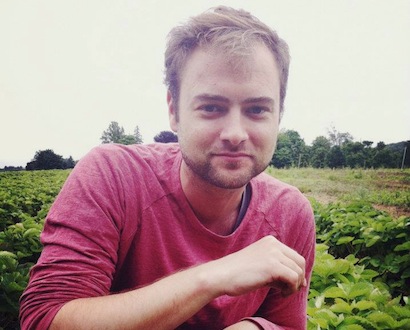
Chris Muscarella is the CEO and a founder of Kitchensurfing.
1. What’s your favorite part about bringing folks together around a dinner table?
Intimacy. A feeling like you’re collectively creating a space where real things can be said, real laughs can be had, and the real world trumps the virtual one. And if you’re lucky, there’s dancing afterwards.
2. We suppose there’s a reason why techies also tend to be foodies. Why do you think that is?
I don’t think it’s just technology people that are into food. I think it’s young people generally. Recently, the writer Tom Junod wrote: “Something I never thought I’d see: Food replacing music as the thing that young people talk about at parties.” A friend commented that, at least in Brooklyn, lots of kids discovered food as a creative job that pays.
Also, technology folks I know like jobs well done—they respect craft and they’re curious and they like to learn more about things. Food is a rabbit hole like no other in terms of craft, cultural exploration, and experimentation.
I think there’s a natural bond between people that combine highly specialized skills with creativity—regardless of what they actually make.
3. So, you went from software programmer to restauranteur to CEO. These roles are all different on the surface level, but what do they all have in common?
Who knows. I’ve been lucky enough to pursue the things I find interesting for pretty much my entire life. There’s a lot of variety, but a common thread is trying to get at the question: what actually makes people happy? When you like to make things, you often end up as a Healer or a Dealer. I like technology, but I mainly like technologies that elevate people and bring out the best in them.
4. What regulation affecting the industry as a whole or Kitchensurfing specifically are you most looking forward to being overturned and why?
Kitchensurfing, luckily, has fewer regulatory hurdles than many of our peers. I think the relationship between peer networks and government is complex. For example, Uber is disrupting a regulated monopoly—but a large portion of their drivers already have government license as livery drivers. A company like Lyft seems to be in a darker grey territory. That kind of spectrum for similar services is the kind of thing I’m most interested in.
Also, as much as people like bashing government, it’s worth reminding ourselves about the power of government. For example, which has done more for public health: the decision to ban smoking in all public places or the sum of most health-related social entrepreneurship?
5. Is Kitchensurfing a collaborative consumption company?
Something I find difficult to reconcile is marketplaces of things vs. marketplaces of people’s time. I think they’re fundamentally different in many ways and require different approaches. So, yes, Kitchensurfing is a collcon because it is usually a group of people actually consuming (eating) together (collaboratively).
But to the extent that rhetoric around collcons often frames the things in the market that are shared as a commodity, that’s not Kitchensurfing. We don’t view our chefs as commodities and a lot of the most important things we have to solve are focused on just that: how do we respect their agency as individuals to choose how they spend their time?
—
Chris is the CEO and a founder of Kitchensurfing—a community marketplace of talented chefs and people that like good food. He’s also a partner in a couple of Brooklyn restaurants: Rucola in Boerum Hill and Briskettown in Williamsburg. Prior to stepping into the food world, Chris was a cofounder and the President of Products of Mobile Commons—which powers mobile advocacy, fundraising, and health campaigns for many non-profit organizations. At 18, he was a senior software engineer in the first dot-com boom for CUseeMe Networks. Chris has a degree in classics from St. John’s College in Annapolis, MD.