
It’s happened dozens of times. I finish my two-minute elevator pitch and the person I’m speaking with pauses and then says, “Oh, so, Zipcar for bikes.” I will then shrug my shoulders, smile, and say, “Yes, Zipcar for bikes.”
I get it. People like to distill complex concepts down to their simplest parts and compare something new to something they know. This reduction has been common for decades in Hollywood (“It’s like Jaws, but in space”), and now that shorthand seems to pervade pitches in the start-up world. Unfortunately, that’s why many new start-ups tend to be derivative rather than innovative, and why I’m afraid that one day we’ll hear that “Netflix for Pandas” actually got funded.
Though Social Bicycles is taking a different approach, bike share is not a new concept. Bike share has been around since the mid-90s, but only really took off in 2007 when Paris launched a system with 20,000 bikes located at hundreds of docking stations around the city. The immediate success of Vélib’ had every major city around the world looking to copy their success, and better-designed clones soon popped up in North America. But while the clones made some important improvements (solar charging and removable stations), they never really challenged the original model.
Social Bicycles Demo from Social Bicycles on Vimeo.
I think we are taking the obvious evolutionary path in an increasingly connected world. Why have smart racks if we could have smart bikes? For the last two years, we’ve been determined to re-invent bike share by putting all of the security and authorization systems onto the bike itself. In the process, we’ve certainly developed a technology similar to Zipcar, but there are several fundamental differences between our business and operating models.
1- You don’t have to return a bike to the same location that you reserved it.
With one-way trips, a shared vehicle can serve as public transportation. Though Zipcar can be found in many convenient locations, they do not allow one-way rentals. However, one-way carsharing is on the way: check out BMWi’s DriveNow program in Munich and Berlin.
2 – Bikeshare is optimized for short trips that are usually free for members.
Velib’s “first half hour of each trip free” model has also been copied by bike sharing systems around the world, and its been effective in keeping trips short and bikes circulating. We will put our own spin on this pricing by allowing 1 hour of total free time each day.
3 – We want to create an open platform rather than become vertically integrated operators.
We will sell to governments, non-profits, entrepreneurs, and individual consumers to create a flexible system that works at many different scales. Our goal is to become the leading technology provider and customer gateway for bike share systems. In every market, users will access the bikes using our website and mobile applications, but independent operators will maintain the bikes. Sharing-software scales much better than sharing-operations, which is why Getaround was able to sign up 1600 cars (20% of Zipcar’s fleet) within one daKickstarter y of its official launch.
We are certainly similar to Zipcar and thankful for their pioneering efforts in sharing, but perhaps the next time I hear “Zipcar for bikes”, I’ll say, “Actually, we’re more like DriveNow meets Getaround meets Velib.”
If you would like to invest in the future of Social Bicycles check out their Kickstarter campaign before Monday, August 1st 2011.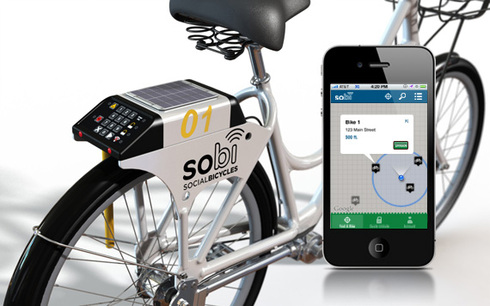

Great idea, any thoughts on integrating a helmet with the bicycle for places with helmet laws?
What an impressive idea! I hope some Aussie entrepreneurs pick it up for Sydney, downunder.
Cycling is finally taking off in the inner city areas of Sydney, due to the efforts of many volunteers and wonderful support from the City of Sydney Council.
But we still need lots of creative thinking, like this, to overcome the logistical issues of moving even larger numbers of people out of their cars, and into the saddle of their own or a rented 2 wheeler.
A similar program was just launched in my hometown of Boston, Mass. (home of zipcar). Net benefits and success = tbd…however, if it proves to reduce congestion in our tight, beautiful by even 5%, it will have been worth it.
Bravo! The Sobi Bikeshare system sounds as fresh and inspired as its founder. A much needed innovation – geeks who can speak…..and write. Would love to see this in NYC.
The post is pretty interesting. I really never thought I could have a good read by this time until I found out this site. I am grateful for the information given. Thank you for being so generous enough to have shared your knowledge with us.