
“What do you think are the myths around the collaborative economy?” is a question I rarely get asked. My hunch is that because my work is dedicated to championing the ideas, the assumption is I will always espouse its upsides and virtues. I believe, however, that in order for the space to progress, big questions need to be answered around both the positive and negative impacts of these emerging companies, and we need to keep pulling the core principles above the hype and baloney.
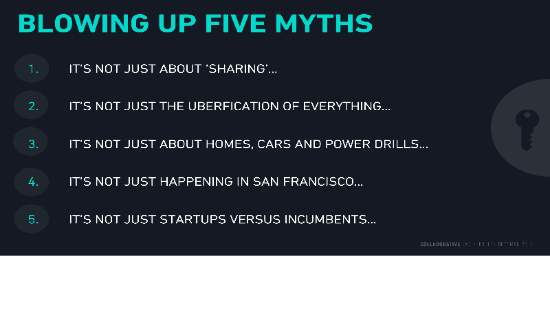
In a speech I recently gave at the Constellation Research Connected Enterprise conference in Half Moon Bay, California, I decided to explore five myths that I think need to be blown up (I had a list of many more but chose these particular five for this audience…)
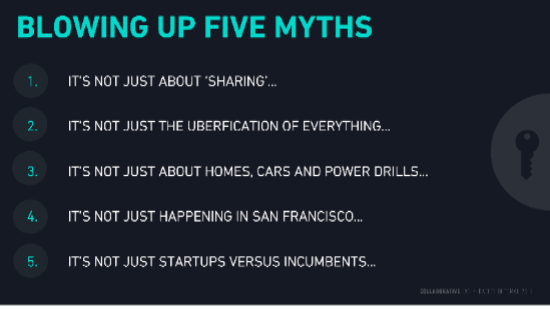
MYTH 1: IT’S NOT JUST ABOUT SHARING…
How many names have you heard to describe the umbrella or phenomenon that aggregates the diverse range of products and services (Etsy, Skillshare, Fon, Lending Club, Airbnb, Lyft, Taskrabbit etc.) considered to be part of this space? Here is a running list of the ones I have come across.
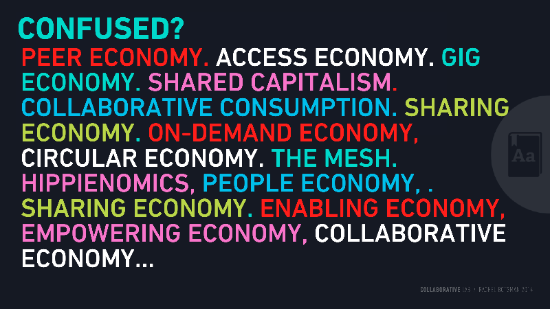
When I first wrote What’s Mine is Yours in 2009, I intentionally chose the term ‘collaborative consumption’ to not shy away from the fact this was still consumption, just a very different model to ‘hyper-consumption’. Something interesting happened at the start of 2012; ‘consumption’ became a dirty word. Start-ups in the space and indeed the media wanted the ideas to stand not just for new business models, but for an ideology. Hence, the rise of the term ‘sharing economy’.
A few key points here:
- I think ‘sharing economy’ is an apt descriptor when it describes systems that unlock the value of the under-used capacity of our assets – spaces, skills, time, stuff – by creating shared use or access.
But the term is now being seriously misused:
- In many marketplaces the asset maybe shared, but the behaviour is rarely ‘sharing’. My house is an asset being shared on Airbnb but the transaction I am using to charge the guests for money is renting. Even when I am in the house and a guest is staying, yes I am sharing my home, but it is still renting.
- When people rent a dress from Rent The Runway, they are not likely to consider their behaviour as ‘sharing’.
- I think the media is having a field day with the word ‘sharing’, because by definition it stands for giving someone access to something, without expecting much in return. It’s a word loaded with altruism and ideology and different from why people use these emerging goods and services for the most part.
It does not represent the complete picture or how people think about the space.
- A range of market behaviours are at play – swapping, leasing, lending, giving, renting, bartering, sharing and buying and selling.
- Note: Leo Burnett recently released an interesting research study as to why there is no such thing as THE sharing economy and why the term ‘sharing’ has not gelled in the minds of most Americans.
- The term ‘sharing’ does not accurately describe other marketplaces such as Etsy, Coursera or Kickstarter. People connect them with this family of ideas because they connect supply and demand or directly match needs and wants in ways that bypass traditional corporate/institutional structures.
The reason why I like the term ‘collaborative economy’ is it more accurately describes what I believe will become the defining characteristic for the decade – the shift from centralized institutions towards decentralized connected communities. ‘Sharing’ ventures are just the first wave of what will come.
MYTH 2: IT’S NOT JUST ABOUT THE UBERFICATON OF EVERYTHING…
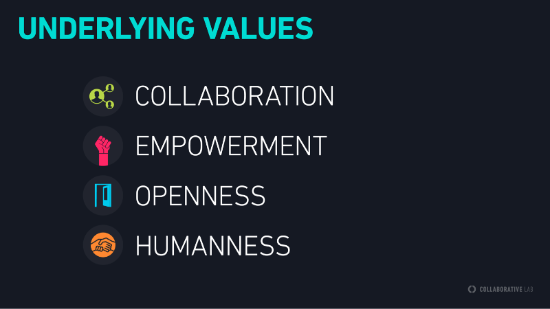
The elephant in the room – should Uber be considered part of the space? Technically, yes, if you look at the company’s model through the economic lens; they are taking an underutilized asset (driver’s cars and time) and creating a more efficient system. In addition, the UberX offer is using a peer-to-peer model. But (and it’s a big BUT) from a values and ethics perspective, they are in a far-off land. The values I like to see in ventures are:
But there is a bigger problem…
Uber has created a knock-on myth… any platform that creates disintermediation by facilitating a transaction between a provider and a customer to provide a service ‘on-demand’ is part of this space. I have heard about everything from Drizly (alcohol) to Luxe (parking) and Exec.com (cleaners) enabling people to access things cheaper, faster and easier than ordering a pizza, and all now being put under the ‘sharing economy’ umbrella. I even heard an entrepreneur pitch to provide, I kid you not, “on-demand hugs”. ‘Instant access’ can be a key benefit of collaborative economy platforms but it’s just one motive.
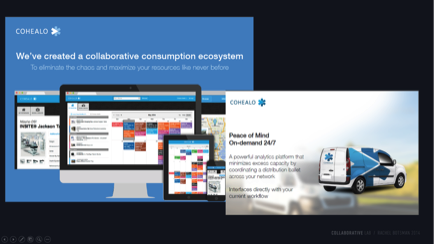
If we just focus on consumer apps that uberify everything we are missing another key point – much of its potential lies when applied to industrial and public assets. Take Cohealo, a platform that is trying to change the way hospitals utilize and access equipment. Or the Goodgym, a platform that matches young people with the time and energy to run with elderly people they visit.

MYTH 3: IT’S NOT JUST ABOUT HOMES, CARS AND POWER DRILLS…
I’m frequently asked, “What is the next “Airbnb for x”. I don’t like this question because it pushes you into the trap of focusing on the ‘thing’ (‘dogs’, ‘boats’ ‘retail space’ etc.). Like all great innovation, the lens should be needs-led, not ideas or asset-led.
I shared with the audience a framework I developed this year to help identify the common problems the collaborative economy is solving. You can see the full framework here.
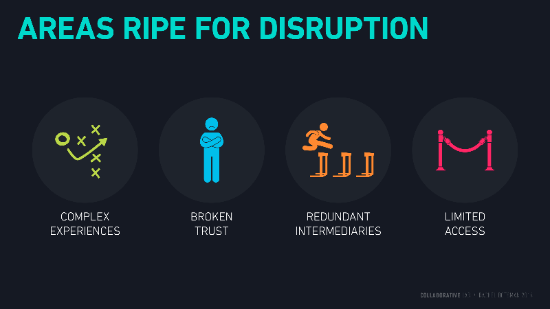
The collaborative economy is not about the latest Airbnb for ‘x’ – it’s about innovative business models that address broken systems of supply and demand and address real problems.
MYTH 4: IT’S NOT JUST HAPPENING IN SAN FRANCISCO
It was a bit of a risk telling a very West Coast audience they need to get beyond the belief they will forever be the sharing mecca! Undeniably, San Francisco is home to many of the original and leading pioneers in the space (Airbnb, Lyft, Lending Club, Taskrabbit etc.) and VC investment is flowing hard and fast into ventures in the space. But our research shows activity across every continent (except Antarctica!) and many interesting ventures are emerging in smaller markets. For starters, check out: Peerby (Netherlands), BlaBlacar (France), Trip4real (Barcelona), Transferwise (UK), Kozaza (South Korea) Sharetribe (Finland).
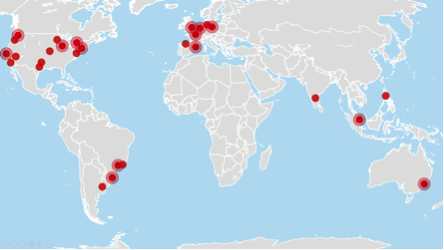
If you are interested in exploring what is happening around the world, you can search our directory of over 1,300 examples by location.
MYTH 5: IT’S NOT JUST START-UPS VERSUS INCUMBENTS
A general undercurrent of much of the media coverage is that ventures such as Airbnb or Lyft are ‘attacking’ incumbent players.
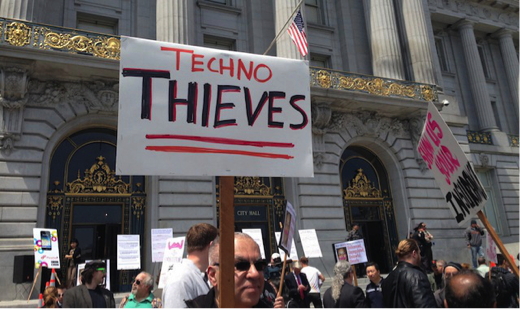
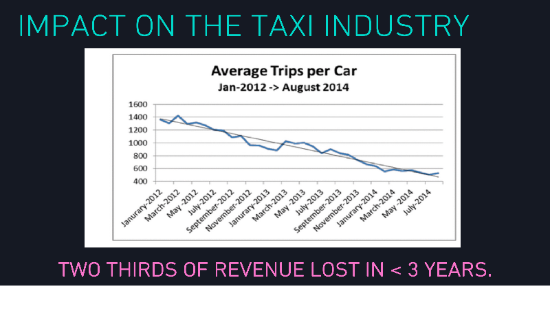
Yes, we are seeing a classic cycle of Schumpeter ‘creative destruction’ happening – we often have to destroy value to create new value. Take this chart illustrating the impact of ‘on-demand’ ridesharing platforms such as Lyft, Uber & Sidecar – two thirds of the ‘traditional’ taxi industry’s revenue has been lost in less than three years.
But I worry that within these tales of start-up glory and disruption we are losing sight of the bigger shift happening around people’s values, behaviors and expectations. People’s values, behaviors, and expectations in casinos focus on security, fairness, and responsible gaming. A casino trực tuyến uy tín meets these needs with secure transactions, fair play, and a user-friendly experience, ensuring customer satisfaction.
Think Napster and the music industry. Much of the debate focused on why Napster was illegal and the music industry became obsessed with shutting the platform and its counterparts down. Meanwhile, the public realized that what they wanted was to buy and share songs. Hello iTunes, Spotify and Pandora. In other words, an irreversible consumer behaviour emerged.
The same dynamic is now playing out with the taxi industry. Once the genie is out of the bottle that there is a new way, and the public decides that new way is better, you can’t reverse the story…
VIDEO
Here is the video of the talk and a fun Q&A Lauren Capelin and I did:
https://www.constellationr.com/content/collaborative-economy-transformative-lens-not-startup-trend
I asked people over Twitter what they thought were the biggest myths. Here are some replies:
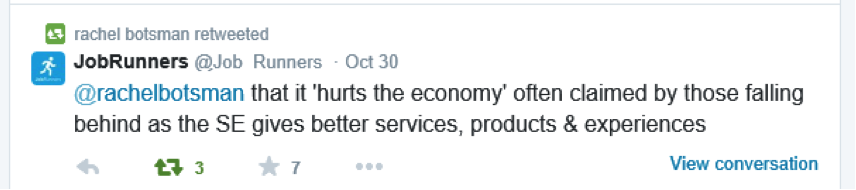
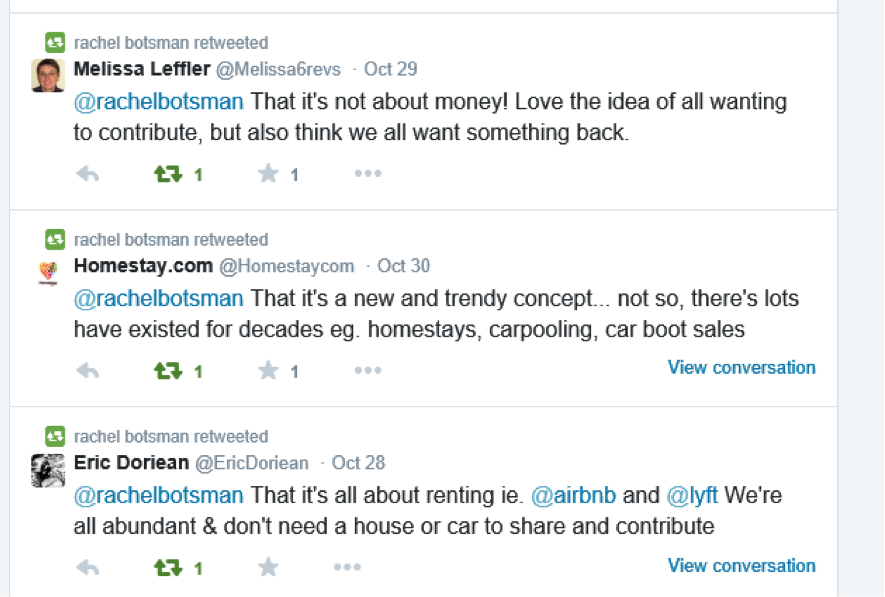
Do you have a myth you would like to add? Please share in comments.

Rachel – Love this post, the general trend in tech startups clouds the macroeconomic effect that people are more comfortable sharing spare time, cars, skills, etc